
A monastery's year is held together by ritual. Pujas and recitations, offerings prepared and dismantled, masked dance in the courtyard — most of it performed much the same way for centuries, and most of it not obviously legible to someone watching for the first time.
These pages are for that person. Each describes one ceremony: what happens, why it is done, how often, how long it takes, and whether visitors are welcome.
Nothing here asks you to believe anything. A ritual is a philosophical position carried out with the body, and it is possible to find that interesting without sharing it.
Annually, over a week in the fourth Tibetan month
The 9th to the 15th day of the fourth Tibetan month; the Gregorian dates move each year.
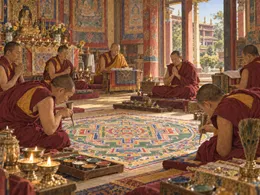
For a week each year the monastery performs the self-initiation of Guhyasamāja on a sand mandala prepared for the purpose. It is one of the central practices of the Gelug tantric tradition, and one of the clearest cases of something the monastery does that is largely invisible from outside.
Dzongkar Choede, Hunsur
more
Annually, at the close of the Tibetan year
The 29th day of the 12th Tibetan month; the Gregorian date moves each year.
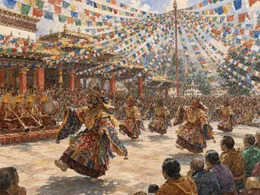
The monastery's own masked dance, performed once a year to close the old year by clearing it. At its centre an oversized yak becomes the deity Vajrabhairava — the form in which he appeared to Lachen Chöpal Zangpo six centuries ago, which is how the dance got its name.
The monastery courtyard, Hunsur
more
These descriptions are drafts, awaiting review by the monastery.