
The Demons in the Cave
June 12, 2026
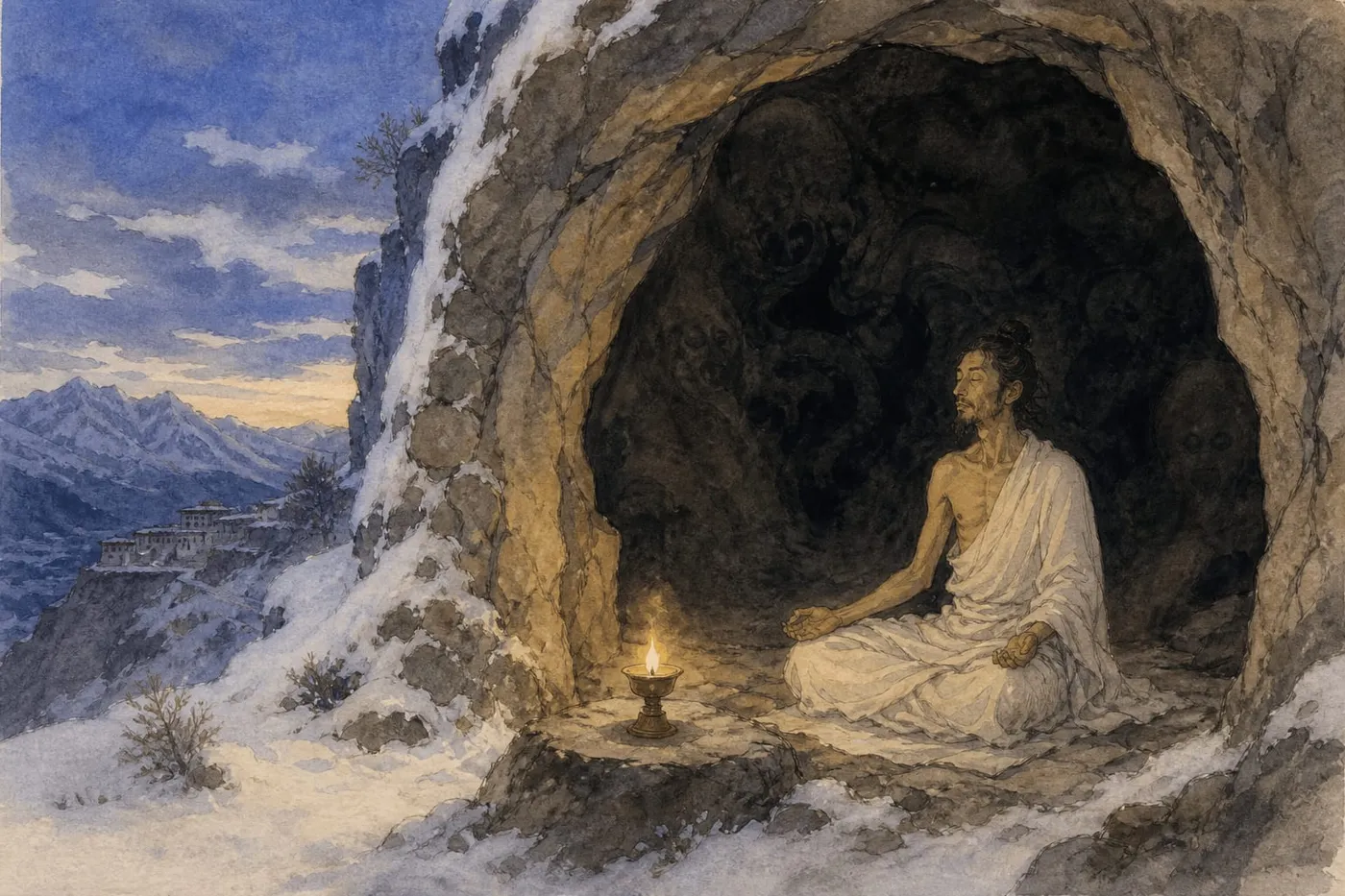
Milarepa climbed back to his cave one evening and found it occupied. Accounts vary on the number; they agree on the manner. The demons had made themselves at home in a space barely large enough for one thin man, and they had no intention of leaving.
He did what anyone does. He ordered them out. He made himself large and told them whose cave it was. They watched him with interest, and did not move. He tried force. They grew. He tried, at last, teaching them the dharma — reasoning with them, explaining emptiness to a room full of teeth — and they yawned, and grew again.
Somewhere in the night he ran out. Not out of technique; out of the energy the fight was running on. And so he walked over to the largest of them, and put his head into its mouth, and said: if you are going to eat me, eat me now.
There was nothing to push against, and the cave was empty.
They had never been feeding on him. They had been feeding on the pushing.
Every anxious person knows this cave. The dread that thickens the harder you try to talk yourself out of it. The intrusive thought at midnight that arrives once, and then arrives forty times because you decided it must not arrive again. The panic that swells precisely in proportion to your determination that it stop — where the second wave is not fear of the thing but fear of the fear, and the third is fear of the second.
Notice that the struggle has its own appetite. It is not a neutral effort against a problem; it is what the problem eats.
This is not surrender to the thing that frightens you. Milarepa did not become the demons’ servant. He became someone the demons had no purchase on.
Turn and face it without the fight in your hands.
Most demons are exactly as large as your refusal to look.
Explore further: Meditation & Inner Practice · Rituals & Sacred Arts