

Education & Intellectual Training
The Five Great Treatises
Everything rests on five texts. They run in sequence, each taking years, and the later ones assume the earlier. A monk does not choose between them.
Pramāṇa — tshad ma
Dharmakīrti, Commentary on Valid Cognition
Logic and epistemology. What does it mean to know something, rather than merely to believe it?
Prajñāpāramitā — phar phyin
Maitreya, Ornament of Realization
The perfection of wisdom: the stages a mind passes through on the way to enlightenment.
Madhyamaka — dbu ma
Candrakīrti, Supplement to the Middle Way
Emptiness. The middle way between saying things exist independently and saying they do not exist at all.
Abhidharma — mngon pa mdzod
Vasubandhu, Treasury of Abhidharma
Phenomenology: mind and matter, karma, rebirth, and the constituents of experience.
Vinaya — ’dul ba
Guṇaprabha, Vinaya Sūtra
The rules of monastic life, and the reasoning behind each of them.
Each of these deserves an account of its own, and in time will have one. What holds them together is that none is treated as a doctrine to be accepted. Each is a position to be defended in the courtyard against whoever wishes to attack it.
The Fifteen Volumes
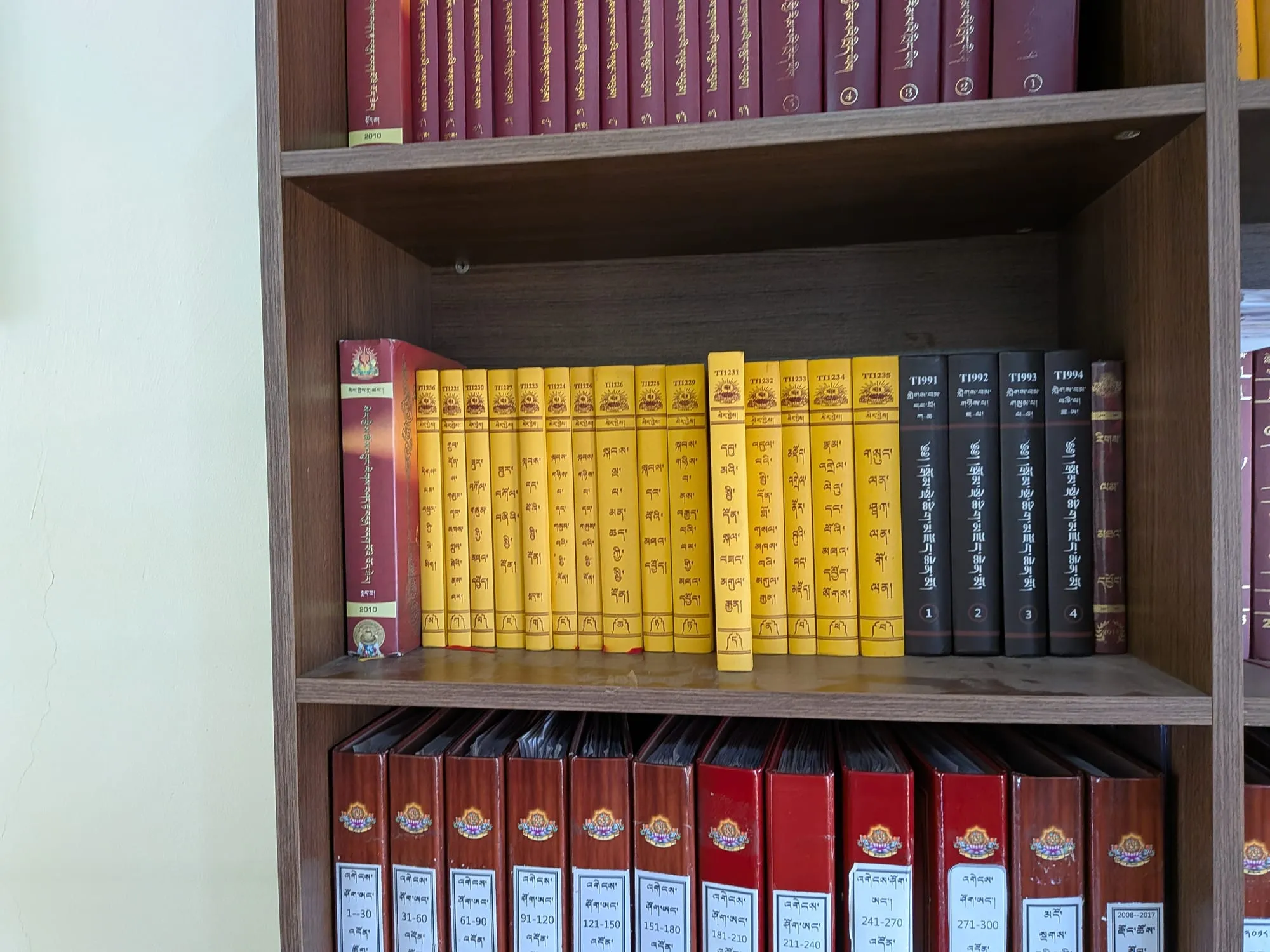
The curriculum on one shelf: fifteen volumes in the monastery library, photographed February 2026.
In the library the whole curriculum occupies a single shelf — fifteen yellow volumes, each carrying the Sera Jey emblem of a lotus beneath a radiant syllable. This is the monastery’s working edition of the five treatises, published by Sera Jey Monastic University at Bylakuppe.
Fifteen volumes, twenty years. It is not a large shelf for a life’s work.
They sit in the Zongchoe Library, begun in 2004 on the personal advice of His Holiness the Dalai Lama, which holds the monastery’s philosophical texts alongside historical and cultural material. In late 2024 its holdings began to be catalogued and digitised, with support from the Department of Religion and Culture of the Central Tibetan Administration.
There is something worth noticing in a monastery that regards the book as secondary nonetheless taking care to make its books searchable and hard to destroy. Losing the texts once was enough.
Memorization Builds the Shelf
Monks do memorize. The root texts are written in short mnemonic verse and are learned by heart, and in the early morning the sound of memorization carries across the monastery.
But memorization is not the education. What it provides is the organizational structure of the whole curriculum — a framework on which understanding can be hung, and a shared text that two monks arguing can both point to. The commentaries and the debates are never memorized. They are retained in relation to the root text, not word for word.
Memorization builds the shelf. It does not decide what goes on it. The traditional sequence is to listen, then to contemplate, and then to debate.
There is a stronger version of this point, and it is easy to miss. In this tradition the written book is not the primary carrier of knowledge. The courtyard is, and the teacher’s oral transmission is. A text is closer to an index — it fixes the wording, so that two monks arguing can point at the same line, but what it indexes is held in people.
That is worth pausing on, given what happened to this monastery. When the community in Tibet was destroyed and fewer than five percent of six hundred monks survived, what came out was not principally a library. It was the monks who had memorised, argued and taught — and that was enough to begin again.
Debate: Where Knowing Is Tested
Twice a day the courtyard fills. One monk sits — the defender, holding a position. Another stands — the challenger, taking it apart. The challenger may be one monk or a dozen, and the exchange is fast, loud, and frequently funny.
Arguments take one of two forms. A syllogism states a thesis and its reason in a single sentence. A consequence — far more common in practice — draws an implication out of what the defender has just conceded, and hands it back to him. The defender has three answers available: I accept, the reason is not established, or there is no pervasion. There is nowhere to hide in it. A position that cannot survive the courtyard is not yet understood.
The clap that punctuates each argument is not theatre. The right hand is method, and especially compassion; the left hand is wisdom; the clap brings the two together. The left foot stamps at the same moment, representing the closing of the door to rebirth in the lower realms. A monk making an argument is enacting the structure of the path while he makes it.
The Disagreement Is the Point
Sera Jey studies the monastic textbooks — yigcha — of Jetsün Chökyi Gyaltsen, who died in the middle of the sixteenth century. His commentaries are themselves written in the form of debates.
Tradition holds that Jetsünpa asked two of his disciples to write commentaries explaining the major texts slightly differently from the way he had — so that students in later generations would be able to sharpen their intelligence by debating the discrepancies. Sera Me, the sister college, still uses one of those variant textbooks today.
The disagreement was built in on purpose, five centuries ago, and it is still running. Which is why debate is not a teaching method the monastery happens to favour. It is what the texts were written for.
The Long Arc
The first three years are not spent on Buddhism as such. They are spent on Collected Topics, on Mind and Awareness, and on Signs and Reason — on learning how to reason at all, and how to hold a position under pressure. Only then does the curriculum proper begin.
Seven years on the Perfection of Wisdom. Four on the Middle Way. Three on monastic discipline. Two on Abhidharma. For those who continue, a further six-year Lharam course ends in public examination and the degree of Geshe Lharampa.
Twenty years, to be examined in a courtyard by anyone who cares to stand up and object. The training this produces is what the monastery means by Buddhist education — and what a young monk arriving at the school is at the beginning of.
The Geshe Degree
What the arc leads to is the degree of Geshe — roughly, a doctorate in Buddhist philosophy, and the qualification that allows a monk to teach.
There are four grades of it. Geshe Doram is awarded on debate before the assembly hall. Geshe Lingsae requires recitation from the five treatises and answering colleagues’ questions. Geshe Tsokram is examined during the winter religious festival, on the abbot’s permission. And Geshe Lharam, the highest, comes after roughly seventeen years of study followed by a further six of written and debate examination — including serving as defender across every class in the monastery, and at the Great Prayer Festival, where topics from all five treatises are debated through the day.
The examination is not written. A candidate sits as defender and is attacked, in turn, by anyone qualified to attack him. He must be able to take up a position anywhere in the five treatises, hold it against objection, and do so at speed. Twenty years of the courtyard are what make that possible.
A geshe may then enter a tantric college to complete his formal training, or return to his home monastery to teach, or withdraw into retreat. Many come back and teach the classes they once sat in, which is how a curriculum nineteen years long renews itself: the monks examining today’s students were examined by the monks who taught them.